Last updated: August 2026
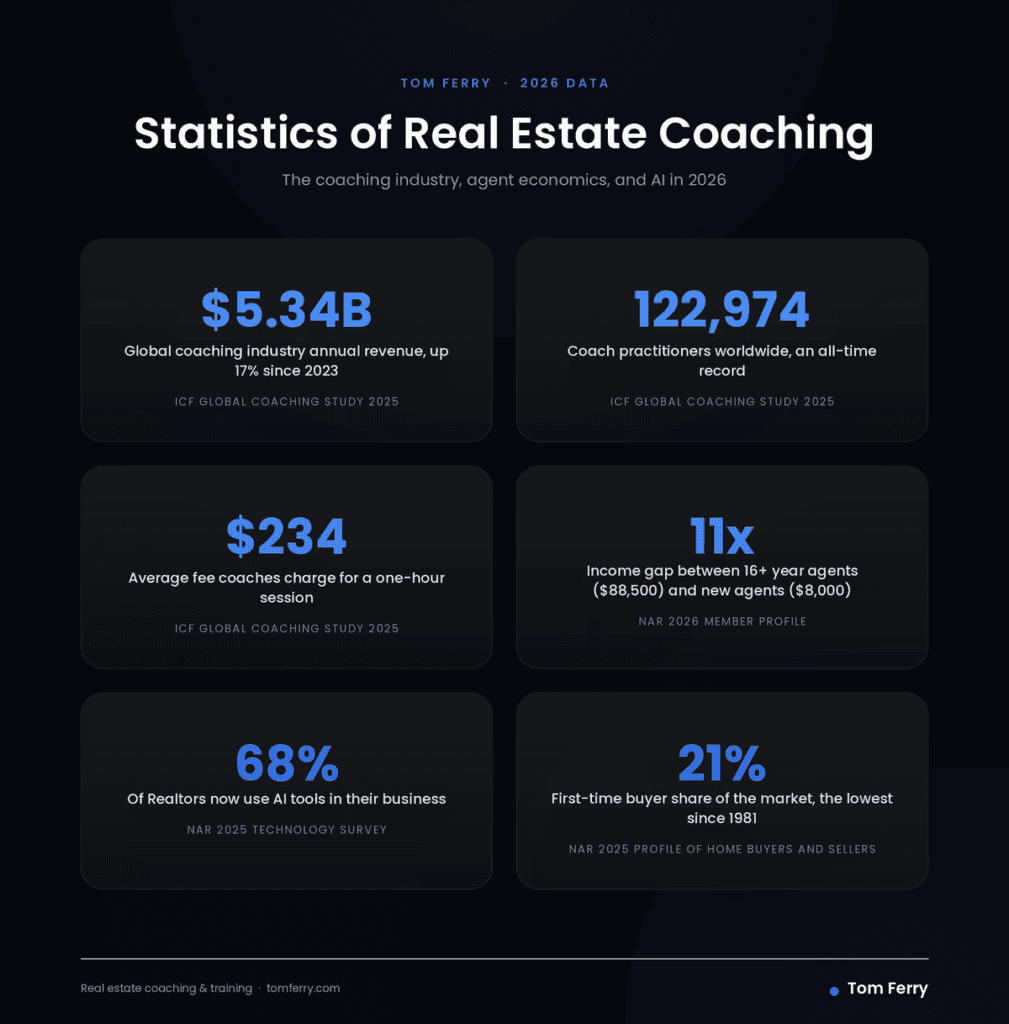
Coaching is now a $5.34 billion global industry, up 17% since 2023, with a record 122,974 coach practitioners worldwide, according to the 2025 ICF Global Coaching Study conducted by PricewaterhouseCoopers.
And the real estate profession those coaches serve has never needed the help more.
The 2026 NAR Member Profile puts the median agent’s gross income at $59,200 on nine transaction sides, in a market running just above 4 million existing-home sales, the slowest pace since 1995.
This page pulls together more than 100 statistics on the real estate coaching industry, agent economics, team performance, consumer behavior, and AI adoption.
Every number comes from a primary source published within the last two years, cited inline where it appears. Use it to benchmark your business, build your 2026 plan, or pressure-test what a coach or a conference speaker tells you.
Key statistics at a glance
- The global coaching industry generated $5.34 billion in annual revenue, a 17% increase since 2023, per the 2025 ICF Global Coaching Study.
- There are 122,974 coach practitioners worldwide, a record high and a 13% increase since 2023 (ICF, 2025).
- Coaches charge an average of $234 for a one-hour session and earn a global average of $49,283 per year from coaching (ICF, 2025).
- The median Realtor earned $59,200 in 2025. Agents with 16+ years of experience earned a median of $88,500, while agents with two years or less earned $8,000, an 11x gap, per the 2026 NAR Member Profile.
- The typical solo agent closed 9 transaction sides in 2025. The typical team closed 32 sides and $17.5 million in volume with a median of four members (NAR, 2026).
- 68% of Realtors now use AI, but only 17% say it has had a significant positive impact on their business, per the 2025 NAR Technology Survey.
- 88% of buyers and 91% of sellers used an agent, while FSBO fell to a record-low 5%, per NAR’s 2025 Profile of Home Buyers and Sellers.
- First-time buyers dropped to 21% of the market, the lowest share since 1981, and their median age hit a record 40 (NAR, 2025).
- 82% of Americans now use AI for housing market information, led by ChatGPT at 67%, per a Realtor.com survey from October 2025.
- Global employee engagement fell to 20% in 2025, driven by manager engagement collapsing from 27% to 22% in a single year, per Gallup’s State of the Global Workplace.
The real estate coaching industry in 2026
Coaching stopped being a cottage industry years ago. The 2025 ICF Global Coaching Study, built from 10,035 valid survey responses across 127 countries and run by PwC, is the sixth edition of the industry’s benchmark research since 2007. Its headline numbers:
- Total annual revenue contributed by the coaching profession: $5.34 billion, up 17% from the 2023 study.
- 122,974 coach practitioners globally, up 13% from 2023 and an all-time record.
- 90% of coaches have active clients, which works out to 110,492 active practitioners worldwide.
- North America alone generates $2.89 billion of that revenue, more than half the global total.
- The average active coach works 11.6 hours per week and carries 12.4 active clients.
- More than 50% of coaching clients are employer-sponsored, meaning organizations, not individuals, now fund most coaching engagements.
The supply side keeps growing, and so does the optimism. 59% of coaches expect their revenue to increase in the coming year.
They expect that growth to come from more clients (60%) and more sessions (51%), not higher prices; only 37% anticipate raising their hourly fee.
Coaches are also expanding what they sell. 60% offer training, 57% consulting, 55% facilitation, and 49% mentoring alongside pure coaching (ICF, 2025). The one-service coach is becoming rare, which mirrors what I’d tell any agent: don’t be a one-trick pony.
Credentials matter more than they used to. 73% of coaches agree that clients and organizations expect them to hold a coaching certification (ICF, 2025). The International Coaching Federation itself now counts more than 62,000 members across 150+ countries, with chapters in over 80 countries.
What coaches earn, charge, and how experience compounds
The economics of coaching look a lot like the economics of real estate: experience compounds hard.
- Global average annual revenue from coaching: $49,283 (ICF, 2025).
- US-based coaches average $71,719 per year, well above the global figure.
- Average fee for a one-hour session: $234.
- Coaches with 10+ years of experience average $69,721 annually, with higher fees, more clients, and more weekly hours than newer coaches.
- Baby Boomer coaches average $60,323 per year and $270 per hour, versus $33,553 and $193 for Millennial coaches.
- 84% of Boomer coaches and 69% of Gen X coaches have more than five years of experience, compared with just 48% of Millennials.
- Specialization deepens with tenure: 80% of coaches with 10+ years focus on business coaching, versus 48% of coaches in their first year.
- Client quality climbs with tenure too. Among coaches with 10+ years, 38% primarily serve executives and nearly 30% serve managers. For coaches with under one year, those figures are 18% and 10%.
A generational handoff is underway. Gen X now makes up 53% of coaches, up from 49%, while Baby Boomers slipped from 38% to 35% (ICF, 2025). The people coaching the next decade of agents will increasingly be practitioners who built businesses through the 2008 crash and the 2020-2022 whiplash, not before it.
The state of the real estate agents coaching serves
You can’t understand real estate coaching demand without understanding agent economics. The 2026 NAR Member Profile, based on 2025 transaction data from more than 5,000 Realtors, describes a shrinking, aging, more experienced industry where the middle is getting squeezed.
Income and production:
- Median gross income: $59,200 in 2025, up slightly from $58,100 in 2024.
- Median transaction sides for an individual agent: 9, down from 10 the prior year.
- Median individual brokerage sales volume: $2.7 million.
- Agents with 16+ years of experience: median income of $88,500, up from $78,900.
- Agents with two years or less: median income of $8,000, on a median of 2 sides and $330,000 in volume.
- Mid-career agents (6-15 years) posted a median individual volume of $3.3 million, the most productive tier in the business.
- Median business expenses jumped to $9,530 from $8,010, so the typical new agent’s expenses now exceed their income.
The gap between a new agent and a 16-year veteran is 11x on income, and rising costs are eating the bottom tier alive. That gap, not motivation, is the coaching industry’s real addressable market: compressing a decade of trial and error into a shorter runway.
The workforce itself:
- NAR membership stood at 1,438,569 as of late June 2026, down from 1,463,352 a year earlier and off the 2022 peak of roughly 1.5 million, per NAR.
- The typical Realtor now has 13 years of experience, up from 12 a year ago and 10 two years ago.
- 75% of members are “very certain” they’ll remain active in real estate for at least two more years.
- Median hours worked: 35 per week (30 for sales agents, 40-45 for brokers who sell).
- 53% are affiliated with independent brokerages, with a median firm tenure of six years.
- 27% of members name housing affordability as the top constraint limiting buyers, ahead of inventory.
All of that against a market running at roughly 4.09 million existing-home sales (June 2026 annualized pace) with a median price of $440,600 and 4.6 months of inventory, per NAR’s existing-home sales data.
Fewer members, fewer deals, higher expenses.
The agents who stay are competing for a smaller pie with sharper competition, which is exactly the environment where skills, accountability, and a real business plan separate earners from exiters.
For the long view, the Bureau of Labor Statistics projects employment of real estate brokers and sales agents to grow just 3% from 2024 to 2034, with about 46,300 openings per year, most of them replacing people who leave.
BLS puts the median wage at $72,280 for brokers and $56,320 for sales agents as of May 2024. Headcount growth is flat for the decade ahead, so every dollar of growth in your business has to come from taking share.



Real estate teams: the leverage story in the data
If you want one dataset that explains why so much modern coaching focuses on team building, it’s this cluster from the 2026 NAR Member Profile:
- 21% of Realtors worked on a team in 2025, with a median of four members.
- Teams closed a median of 32 transaction sides, versus 9 for individuals.
- Median team sales volume: $17.5 million, versus $2.7 million for an individual brokerage specialist.
- 54% of teams closed $10 million or more in volume.
- Team-based residential specialists typically closed $11.9 million; commercial specialists on teams reported $21 million.
A four-person team producing 32 sides is 8 sides per head, roughly what a solo agent produces alone.
The team premium comes from consistency, coverage, and the ability to buy leverage: admin, marketing, and lead flow that a solo agent can’t fund on 9 deals.
Whether you should build one depends on your model, and picking the wrong team model is one of the most expensive mistakes an agent can make.
The consumer agents must win in 2026
NAR’s 2025 Profile of Home Buyers and Sellers, drawn from 6,103 responses covering transactions from July 2024 through June 2025, describes the most concentrated, most experienced consumer pool in the survey’s 44-year history:
- 88% of buyers purchased through an agent or broker.
- 91% of sellers used an agent, and only 5% sold FSBO, the lowest share ever recorded.
- Agent-assisted homes sold for a median of $425,000 versus $360,000 for FSBO sales.
- First-time buyers fell to 21% of the market, the lowest since tracking began in 1981. The pre-2008 norm was about 40%, and the share has contracted roughly 50% since 2007.
- The median first-time buyer is now 40 years old, a record. The median buyer overall is 59, repeat buyers are 62, and sellers are 64, all records.
- Repeat buyers are 79% of the market, and 30% of them paid all cash.
- Median down payments: 10% for first-time buyers (highest since 1989) and 23% for repeat buyers (highest since 2003).
- Median buyer household income: $109,000 ($94,400 for first-time buyers).
- Buyers faced an average mortgage rate of 6.69% and searched for a median of 10 weeks.
- Sellers had lived in their homes a median of 11 years, another record, and buyers now expect to stay 15 years, with 28% calling their purchase a “forever home.”
Translate that into a business plan.
Your 2026 buyer is older, wealthier, and more experienced than any buyer pool on record, and your seller has 11 years of memories and equity in the house. Scripts written for 2016’s 32-year-old first-time buyer don’t work on a 62-year-old repeat buyer paying cash.
The agents winning this market are the ones whose skills, marketing, and database strategy match who’s transacting now, which is precisely the gap good coaching and training exist to close.
AI adoption among agents: wide but shallow
The 2025 NAR Technology Survey, fielded in July 2025 across a random sample of 49,233 Realtors, found AI use is now the norm:
- 68% of Realtors use AI in their business: 20% daily, 22% weekly, 27% a few times a month. 32% haven’t started.
- The tools: ChatGPT (58%), Gemini (20%), Copilot (15%). 21% use a CRM with AI-powered insights, 7% use chatbots for lead capture, and 1% use digital twins.
- 46% use AI-generated content, mostly listing copy and marketing.
- But only 17% report a significant positive business impact from AI. 33% report a moderate impact and 46% see no noticeable difference at all.
- 91% of all real estate agents are invisible in AI search in 2026 (report from FlyDragon)
Two-thirds of the industry adopted the tool; one in six turned it into money. Adoption isn’t the edge anymore. Implementation is.
A February 2026 Realtors Property Resource survey of 225 NAR members put adoption even higher at 82%, and the divide it describes runs between agents who bolted AI onto old workflows and agents who rebuilt their workflows around it.
The rest of the tech stack, per the same NAR survey:
- eSignature remains the most-used tool at 79%, followed by social media at 75% and drone photography at 52%.
- Social media is the top source of quality leads (39%), ahead of CRMs (23%), the local MLS (17%), and brokerage websites (13%).
- 34% of agents spend $50-$250 per month on technology; 24% spend more than $500.
- 82% say clients respond positively to technology in the transaction, and 67% agree their brokerage gives them the tools they need.
The Real Brokerage’s June 2025 agent survey adds texture from a tech-forward brokerage: 58% of its agents use AI daily, 58% use it to streamline client communications, and 34% use it for market analysis and forecasting.
68% named time savings as AI’s biggest benefit, while just 14% credited it with improving marketing effectiveness and 29% worry about inaccurate or biased output.
Consumers are already using AI to find homes and agents
Your clients moved faster than the industry did.
- 82% of Americans use AI for housing market information, per a Realtor.com survey from October 2025. ChatGPT leads at 67%, Gemini at 54%.
- The same survey: nearly 90% turn to social media for housing content, led by YouTube (73%) and Facebook (57%), and 76% of Gen Z name TikTok as a go-to housing source. It also found that only 28% of homes are affordable to the typical household.
- 45% of prospective buyers have used AI tools in their home search, up from 37% a year earlier, per Veterans United’s 2026 homebuying survey. The top uses are finding available homes, estimating payments, and checking property values. 49% of Americans now use AI at least once a day.
- Bank of America’s Homebuyer Insights Report found that 20% of prospective buyers and homeowners have used AI or chatbots for homebuying research, rising to 28% of Millennials and 32% of Gen Z.
- Cotality’s 2026 housing survey, reported in the same NAR analysis, found 55% of buyers use generative AI at least monthly, 75% assume AI is already influencing parts of the homebuying process, and 44% would pay more for a human professional.
Two conclusions.
First, the consumer’s research journey now starts in a chat window and on YouTube, so if your name, your market data, and your video content don’t show up there, you’re invisible during the phase where trust gets built.
Second, the human premium is real and measurable: consumers say they’d pay more for professional guidance even while using AI daily. Video-first marketing plus verifiable expertise is how you collect that premium.
Why real estate coaching demand keeps rising
Coaching demand doesn’t grow in a vacuum.
It grows because performing under pressure without support is failing, and the workplace data shows it.
- Global employee engagement fell to 20% in 2025, the lowest since 2020 and the second consecutive annual decline, per Gallup’s State of the Global Workplace.
- The collapse is concentrated in leadership: manager engagement fell from 27% to 22% in a single year, down from 31% in 2022. Individual contributors held near 19%.
- Gallup priced the prior year’s engagement drop at $438 billion in lost productivity, and estimates each percentage point of lost engagement represents about 21 million fewer engaged employees worldwide.
Real estate agents are effectively self-employed managers of their own one-person companies, with none of the structure that keeps a W-2 manager upright.
The ICF data shows where the market is responding: organizations now sponsor more than half of all coaching engagements, and coaching revenue grew 17% in two years while global engagement fell.
Organizations are buying structure, accountability, and skill development because the default environment no longer provides them.
Emerging trends and what’s new for 2026
Coaching is becoming a technology business.
In the 2025 ICF study, 54% of coaches say improved coaching platforms and technology-driven solutions are a priority for meeting future client demand. 47% already use digital coaching platforms, mostly for virtual one-on-one sessions (35%) and scheduling and client management (23%).
But only 19% of coaches invested in new technology in the past year, expected to rise to 27% within one to three years, and 37% call adapting to technology a major concern.
The coaching industry has the same adoption-versus-implementation gap as the agents it serves.
The industry is consolidating around experience. Realtor headcount is down roughly 25,000 year over year while median experience climbed from 10 to 13 years in two annual reports. Fewer, better agents fighting for 4 million transactions rewards skills training over recruitment-driven models.
Teams keep absorbing production. With 21% of agents on teams producing 32-side medians against a 9-side solo median, the structural question for every agent above roughly 20 deals is no longer whether to build leverage but which model to build.
The consumer search shifted surfaces. With 82% of consumers using AI for housing information and ChatGPT alone reaching 67% of them, being recommendable to an AI assistant is becoming a marketing discipline in its own right, alongside the YouTube and social presence that 90% of consumers already lean on.
AI is an efficiency story so far, not a revenue story. Agents report time savings (68% at Real), not marketing lift (14%), and only 17% of Realtors see significant business impact. The gap between the two is a coaching opportunity: tools don’t convert; implemented systems do.